AI for Site and Land Development
AI Utility Layout Generation for Small Subdivision Projects
Automated pipe and road design compresses weeks of prep work into reviewable drafts.
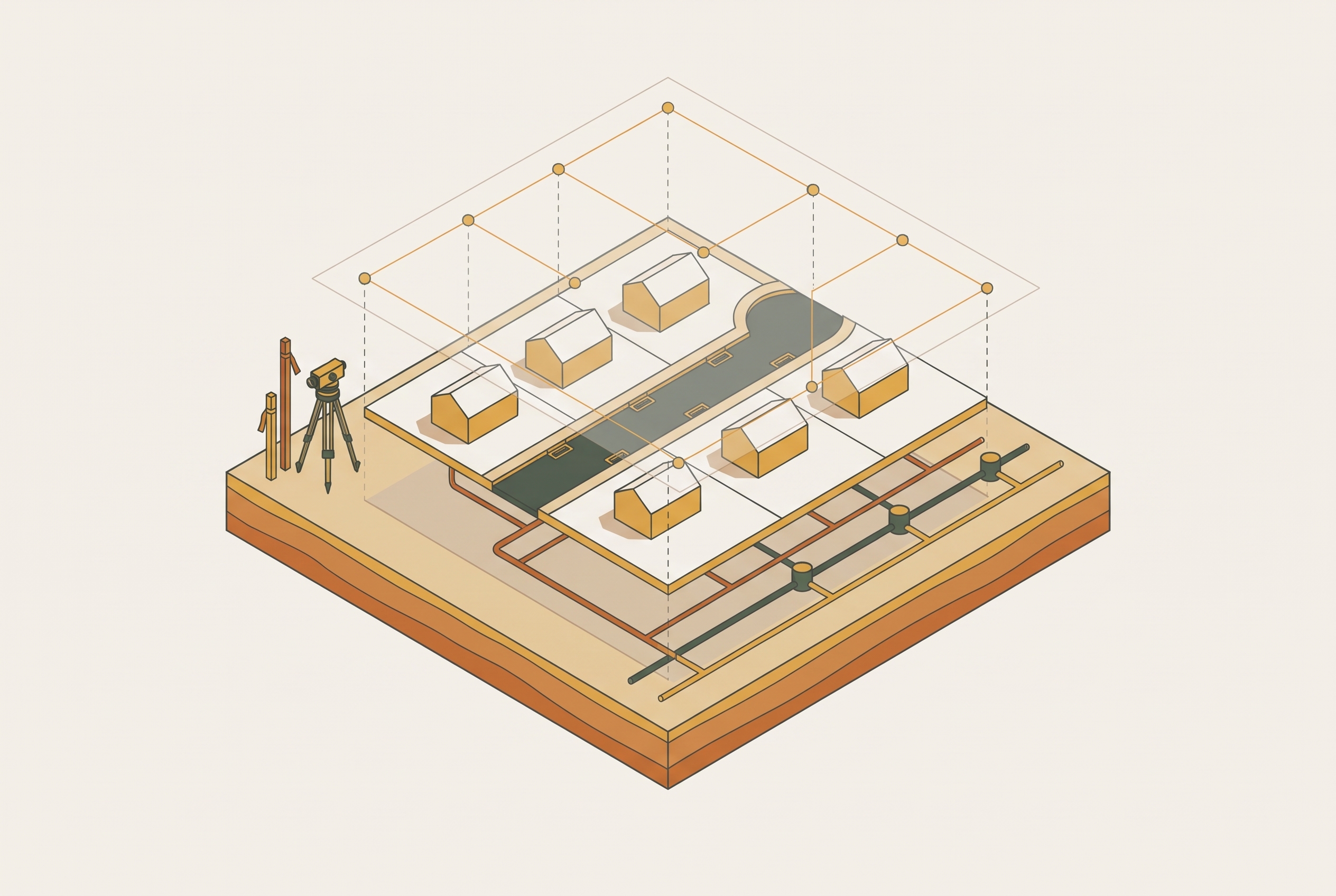
AI utility layout generation for small subdivision projects automates the design decisions that lead from road geometry to underground pipe networks. Its value is faster preparation of work that a licensed engineer can review and finalize. For small civil teams, productive adoption means understanding that sequence, standardizing its inputs, and buying tools that fit the firm’s existing workflow.
What AI utility layout generation actually does, step by step
The workflow begins with a 2D site boundary and zoning constraints. From those inputs, the system generates candidate road networks and lot layouts against requirements for yield, setbacks, easements, and access. It evaluates multiple options rather than producing a single arrangement for the engineer to adjust manually. These constraints define the design space.
Surface and roading design comes before the design of underground infrastructure. Project Assist AI, a built-in part of Corridor EZ for Civil 3D, lays out the road network for a subdivision from a 2D design. The road network establishes the geometry for subsequent work. Pipe routing must follow that geometry, so road generation is a design stage that the pipe work depends on.
Allsite.ai’s Service AI addresses the underground layer by automatically designing storm sewer, storm drain, and sanitary pipe sizes and invert levels. It generates pipe networks that meet local engineering requirements. This is not merely a sizing check applied to a network that an engineer has already drawn. Pipe dimensions and elevations are part of the generated design itself, making underground infrastructure a second design layer in the sequence.
The order governs what can be generated next. Road geometry constrains pipe routing, routing constrains invert levels, and invert levels constrain outfall design. Where tools handle all four stages in order, the connected workflow can compress a multi-day iterative loop into a single automated pass. Output exports to CAD and GIS formats, giving the engineer files inside familiar design tools and eliminating the need to transcribe a PDF.
Where licensed engineer judgment remains mandatory in the AI-generated output
The exported network is a draft. A planner and an engineer must review AI-generated plans before they are submitted, and the civil engineer still reviews and finalizes the plat. Licensed judgment makes the speed gain trustworthy. That review includes whether pipe sizing assumptions match the local hydrology model, whether invert levels accommodate tie-in constraints at the right-of-way, and whether the drainage network respects downstream capacity. Selecting among layouts optimized for lot yield also requires judgment about constructability, soil conditions, utility conflict, and municipal preference. Those decisions depend on site knowledge the AI does not have, while the quality of the candidates depends on constraints and parameters that people standardize in the firm’s BIM and CAD workflows. The apparent objection is straightforward. If most pipes are right, why not approve quickly? The answer lies in the failure cases, including a wrong invert at a low point or an undersized culvert at a detention pond outlet. Those are precisely the errors that can produce expensive field change orders or permit rejection. A licensed stamp is the accountability mechanism.
Why this compression matters most for small civil teams working subdivision projects
A 40-lot subdivision still needs a full road network, a complete storm sewer design, and the associated invert calculations. The sequenced decisions remain the same as those on a 200-lot project, even though the site is smaller. Project size does not remove those dependencies. A small civil team must still work through how the road, pipe, elevation, and drainage fit together before it has a coordinated design to review. The workload becomes disproportionate because the design obligations remain while the staff available to meet them is limited.
For a team of three to five engineers, several days spent laying out one small subdivision consume a substantial share of available engineering hours. Those hours spent on one project limit the team’s capacity to open another, providing the practical constraint behind the automation argument. When generation compresses the preparatory work into something reviewable in a fraction of the time, the same team can open more subdivision projects per quarter without adding headcount. Review remains part of the work, but manual generation no longer occupies the same share of it.
Automating an isolated calculation offers a narrower benefit than compressing the dependent decisions that keep a layout moving through successive revisions. For small subdivision teams, that distinction is important because the same engineers have limited hours across their projects. A faster road layout is useful on its own. Its broader value emerges when the following infrastructure stages can proceed from it without recreating the same manual sequence.
Small firms also have a timing advantage. Large firms can move slowly, and many are still evaluating tools bought before the technology was ready. A nimble small firm can adopt and become productive within a quarter while a 500-person firm spends two years debating adoption. That opportunity depends on a focused implementation, however, rather than treating the entire subdivision design process as one undifferentiated automation task.
Surface and roading design comes before the design of underground infrastructure.
What the tool category actually covers today, and what it does not yet handle
Current production capabilities include road network generation, storm and sanitary sewer sizing, and invert generation. Automating these stages differs from producing a complete design in which every utility system fits together. A firm evaluating the category needs that distinction to avoid both dismissing useful tools and expecting them to handle work outside their scope.
Project Assist AI does surface and roading design from a 2D layout within Civil 3D. Service AI covers underground pipe sizing and invert levels, including storm and sanitary networks. These are documented, shipping capabilities rather than proposed applications of generative design. Their scopes are nevertheless different. A road-generation capability does not establish underground network capability, and automatic sanitary pipe sizing does not establish complete sanitary system design.
The remaining gaps are specific engineering tasks. Tools in this category do not yet fully automate water distribution network modeling with pressure analysis, sanitary sewer design with lift station sizing, or utility conflict resolution across all wet and dry utility layers simultaneously. Engineers still have to do those tasks outside the generative output. Even when a tool handles sanitary sizing, the firm must check whether it also covers the project’s lift station requirements.
Other AEC tools occupy different parts of the design process. Autodesk Forma addresses site planning, massing, environmental analysis, and early design decisions, while ArkDesign addresses automated floor plan generation. Neither establishes an underground pipe network design capability. More broadly, generative design also covers repetitive layouts, structural sizing, duct and conduit routing, and early massing studies. That broader category should not be mistaken for interchangeable civil utility functionality.
VIKTOR represents a different route to engineering automation. Its platform allows engineers to build and use apps, workflows, and agents that turn engineering knowledge into reusable automation. It is relevant to firms considering custom workflows beyond off-the-shelf coverage. A platform for building automation, however, is a different proposition from a purpose-built tool that already generates a defined subdivision design stage.
How a small civil firm actually integrates AI layout generation into its existing workflow
For a small civil firm, the practical starting point is a workflow audit. The firm should identify which subdivision layout stage consumes the most engineer hours and has the clearest repeatable constraints. Both conditions are important to the choice. A time-consuming stage offers a useful target, but codifiable constraints give the tool a defined basis for generating output. Treating adoption as an installation problem alone leaves that underlying design work unresolved.
The next step is to standardize those constraints and parameters in the firm’s existing CAD and BIM workflows. The tool generates against the inputs it receives. When the firm’s standards are inconsistent, the output is too, which adds to the review work. This preparation also gives the team a shared way to check whether a generated layout follows firm practice. The constraint set becomes a shared part of the engineering workflow.
A phased introduction can begin with road network generation on one active subdivision project. The engineer should review the output against what would have been produced manually and identify where the tool’s assumptions diverged from firm practice. Those differences provide a basis for refining the constraint set before wider use. The pilot has a specific purpose. It tests the fit between the generated design and the firm’s standards, rather than merely demonstrating that the software can create a layout.
Training should address review judgment as well as operation. For utility layout AI, the central question is which outputs can be trusted without manual verification and which always need a check. Knowing the interface alone does not answer it. An internal champion should understand both the tool and the firm’s subdivision workflow, build the constraint library, and train other engineers. That role helps turn an occasional individual tool into a repeatable team practice, while keeping the generated work within the firm’s existing design and review process.
Why buying a purpose-built AI tool is the right call for most small civil firms, not building one
Building an in-house utility layout AI tool is a poor use of resources for most small civil firms. The required expertise, development cost, and pace of AI change make it difficult to justify replicating capabilities that purpose-built tools already provide. McKinsey’s guidance for the AEC sector is direct. AEC firms have historically struggled to build and scale software products, and AI is advancing too quickly for most incumbents to rely primarily on internal development.
McKinsey also finds that AEC firms overinvest in generic AI capabilities while underinvesting in areas of lasting strategic advantage, including the systems and workflows where core decisions are made. For a small civil firm, those advantages are its expertise in subdivision design, its ties with clients, and its knowledge of local regulations. They are not interchangeable with software development expertise. Investing engineering hours in standards, constraints, and review practice strengthens the work the firm is already equipped to deliver. Building a general capability that vendors already supply diverts those hours elsewhere.
Purpose-built tools handle decisions in sequence that would take years and a great deal of money to build into an in-house tool, while buying access costs a fraction of that amount. Maintenance adds a continuing obligation. Purchased tools place responsibility for model updates, compatibility with Civil 3D releases and ArcGIS updates, and integration maintenance with the vendor. An internal build leaves the small firm responsible for that burden permanently.
The firm should evaluate tools against the stages where it loses the most time and confirm that output formats can be read by its existing software. Vendor onboarding also belongs in the decision. Hands-on implementation support can shorten the path to productive use, particularly when the work involves translating firm standards into usable constraints. Buying software and building a firm-specific constraint library are complementary decisions.
The competitive window is open but not indefinite. Only a small minority of AEC firms have reached widespread AI adoption, while early movers report measurable project benefits at a rate that far exceeds light adopters. A small subdivision practice has fewer steps to make a decision, so it can get a workflow running while other firms are still weighing their options.