AI for Site and Land Development
AI for Preparing Construction Plan Sets on Site Development Projects
AI drafts the base, surfaces, and notes while engineers keep the stamp.
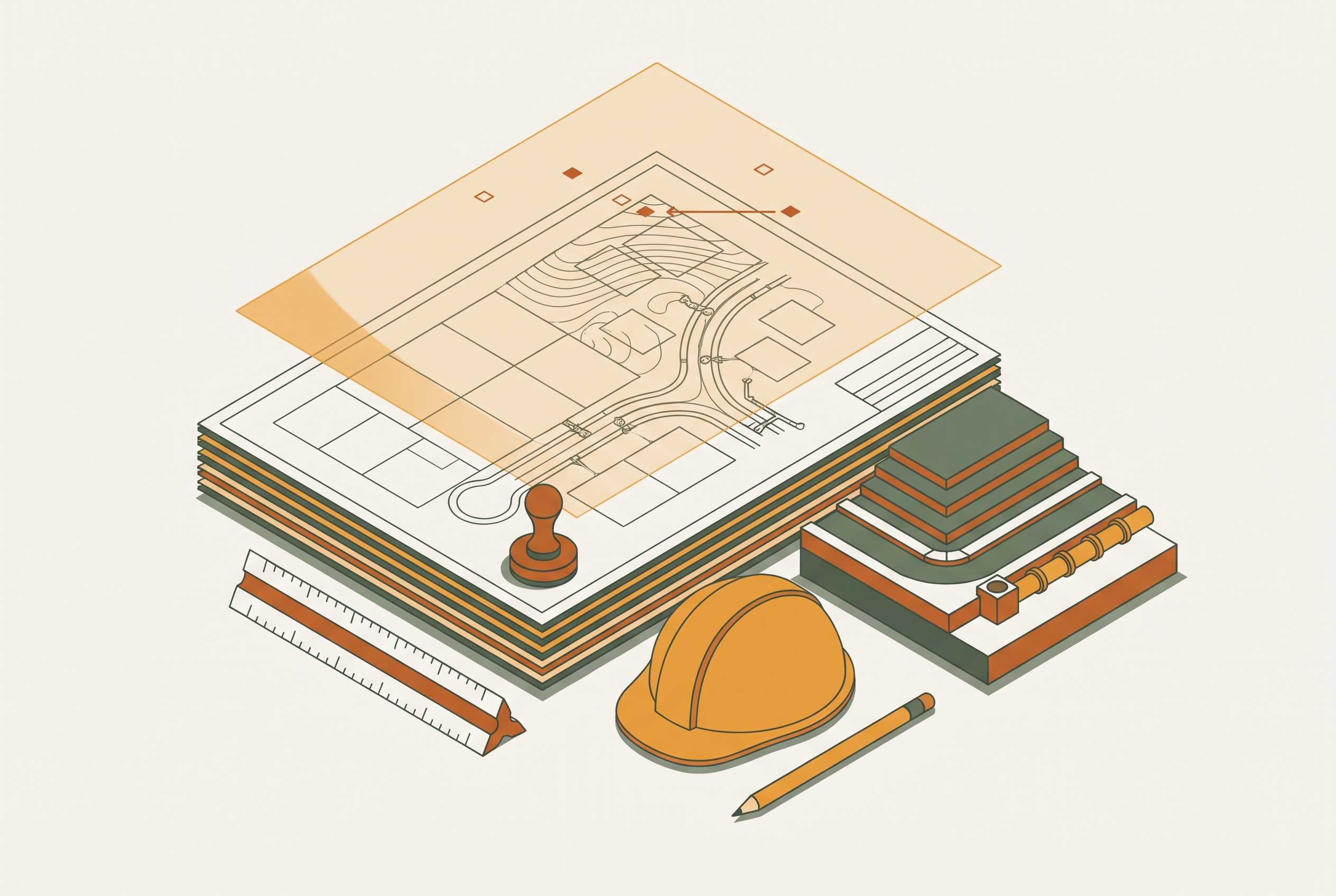
Preparing construction plan sets for site development is a sequence of linked production tasks, several of which AI can now handle from input to draft output. Engineering time shifts while professional responsibility remains with the licensed engineer. AI prepares the base, surfaces, coordination findings, and documentation so that licensed engineers can concentrate on design decisions, technical review, and delivery.
What a site development plan set actually requires before AI enters the picture
A site development plan set begins with base mapping and existing conditions, followed by grading and earthwork design, utility layout, and stormwater and drainage design. Detail sheets, general notes and specifications, and plan check response complete the production sequence. The base guides grading, grading guides drainage, and drainage affects utility coordination, so an earlier decision can mean changes to several drawings later in the process. Details and notes can be finalized only when those drawings reconcile.
That dependency also defines the review structure. Each deliverable must support the next without introducing conflicting elevations, requirements, or instructions. The licensed engineer stamps the finished set and owns its engineering decisions.
Base mapping and existing conditions without drafting from scratch
Base mapping converts aerial imagery, survey points, and GIS data into a CAD-ready existing-conditions drawing. AI can perform that assembly substantially faster than manual drafting, with output feeding directly into Civil 3D as a live design base. The engineer starts with a drawing to evaluate. Instead of constructing every feature from source material, the engineer reviews extracted contours and site features, corrects discrepancies, and assesses the base’s suitability for design.
Recent aerial capture also changes the currency of the drawing. An AI-generated base can show recent visible site conditions as well as those recorded when the last survey was completed. Survey verification and legal boundary reconciliation remain distinct professional responsibilities when imagery is used. The engineer must still check whether the extracted information matches ground truth before using it as the base for grading.
Where base mapping overlaps with site selection, environmental analysis adds another input to early feasibility. Autodesk Forma, formerly Spacemaker, analyzes sun exposure, wind patterns, and noise levels to inform that assessment. Boundary determination remains separate from its role in early site analysis.
Grading design and earthwork through automated surface generation
Grading provides the clearest evidence of production and construction-cost gains because surface design combines intensive manual work with consequential earthwork decisions. Automated grading engines can generate surfaces that meet slope, drainage, and constructability requirements in a fraction of the time manual design takes. The benefit extends beyond faster drawing preparation. On a 38-acre site in San Francisco, AI automatically generated roadway surfaces in place of manual design, which led to large savings in earthwork grading.
The engineer’s task shifts from manually shaping the surface to evaluating the proposed result against site constraints and local standards. Refinement remains an engineering decision. Bentley’s OpenSite+ offers AI-assisted drawing production for site grading and civil documentation, with claims that it takes less time, leads to fewer errors, and makes the work more consistent. Those claims describe the production opportunity, while the San Francisco project demonstrates the separate value of generating a surface with substantially lower earthwork demands.
Civil 3D dynamically links grading, drainage, and pipe networks so that grading changes can update drainage catchments, pipe network inverts, and associated drawings. This reduces manual reconciliation across the plan set. The engineer can then assess how a changed surface affects the design without having to redraft each affected sheet on its own.
Civil 3D 2026.2 greatly increased what Dynamo automation can do with individual stormwater control objects, and AI-powered node autocomplete suggests which node to connect next. Natural-language-adjacent prompts can help generate scripts, extending access to engineers who are not programmers. The engineer still selects the applicable drainage standard, resolves non-standard agency requirements, and decides when site conditions warrant an exception.
Utility layout and coordination before conflicts reach the field
Utility coordination connects the civil design to structural and MEP work, where unresolved conflicts can generate expensive field rework. AI drawing-review tools cross-reference information at this stage, before the drawings are issued for construction. The review extends beyond model geometry alone. A model-level clash check looks at how the physical parts fit together, while sheet-level review checks the callouts, elevations, and dimensions in the documents sent for permit.
InspectMind reviews civil engineering drawings for land development, transportation, and water resource projects, cross-referencing grading plans, drainage designs, utility layouts, and site plans against building drawings and codes. Helonic flags conflicts between civil drawings and architectural or structural sets, including disagreements in spot elevations, slopes, and drainage callouts. Both operate at the sheet level. That makes their findings relevant to the actual permit package, where inconsistent annotations can trigger plan check comments even when model coordination has been addressed.
The engineer then reviews a conflict report rather than finding every discrepancy through manual red-lining. A flagged disagreement is not itself a design instruction. Some findings require redesign, while others require clarification so that the sheets communicate the intended design consistently. Distinguishing between those responses remains the engineer’s work.
Each deliverable must support the next without introducing conflicting elevations, requirements, or instructions.
Detail sheets and general notes drawn from the firm’s past work
Once the design is coordinated, detail sheets and general notes translate it into construction requirements. Much of this work involves retrieving and adapting prior material. The firm’s history becomes a production asset. AI trained on past plan sets, standard details, and jurisdiction-specific note blocks can surface relevant material and draft notes in the firm’s established format.
That retrieval is more useful when it includes context. Tools that have ingested historical drawings can identify a standard detail for a given condition, flag a note block that is outdated relative to the current code edition, and reflect local agency preferences. A generic drafting tool has no such grounding in the firm’s past work. Repeated work in a jurisdiction gives the historical library information about preferred note formats and required details that AI can make explicit and reusable.
SWAPP provides an example of automation at the documentation layer by generating drawing sets directly from design models. The distinction is between producing documentation and deciding whether it is appropriate. For site development, the reviewing engineer must check whether a retrieved detail fits the actual condition and whether the notes meet current permit requirements. Familiarity with a prior detail does not establish its suitability for a new site.
Plan check response and the decisions the engineer must own
Plan check response combines correction lists, written responses, drawing markups, and resubmittal assembly. AI can accelerate this document-intensive work by locating references and preparing draft material for review. A jurisdiction comment may identify a drawing inconsistency, but it may also require interpretation of a requirement or reconsideration of the design.
InspectMind can process large drawing packages, providing a basis for locating the sheet and callout to which a correction applies. That reduces the effort of manually tracing references through the set. AI can then draft a response letter in the firm’s format, identifying the corrected sheet and describing the change made. The engineer reviews that account for technical accuracy and approves it, rather than treating a well-formed response as proof that the correction is adequate.
Ambiguous comments still require professional interpretation. The licensed engineer decides what the reviewer intends, whether a proposed revision satisfies that intent, and whether related parts of the design must change. AI cannot take professional responsibility for the resubmittal. The engineer’s review and stamp provide the correct structure for engineering work supported by automation.
Where the engineer’s time actually goes when AI handles production
Across these stages, the change is from creating each production artifact manually to evaluating prepared work and resolving decisions that do not fit standard rules. Engineers spend more time on site-specific constraints, design alternatives, agency relationships, and technical review. These are substantive uses of engineering expertise. An engineer reviewing an automated surface can focus on whether it suits the site, while one reviewing a coordination report can decide which discrepancy requires a design change.
A real project substantially reduced the required effort from 750 hours. With more engineering time available, the same team can take on more projects, get work to clients faster, and bring in more revenue per person. In a constrained hiring market, that provides a route to growth without adding headcount.
Those outcomes depend on where the released time goes. Faster base mapping alone does not determine how many projects a firm can deliver if technical review or agency coordination remains unresolved. Throughput is therefore the more useful measure. It shows how gains in production lead to finished work and keeps the focus on the engineering decisions needed to move a project forward.
What determines whether AI works for a given firm
To get these results, a firm needs tools that fit its workflow, good data, and staff who are ready to use them. A suitable tool works inside the firm’s existing environment rather than requiring it to abandon Civil 3D, Revit, or its established CAD workflow. Replacing core working methods imposes an adoption cost that can exceed the benefit of automating a particular task.
Consistent BIM parameters, naming conventions, and data pipelines support consistent outputs, while inconsistent project data produces inconsistent results. The dependency varies with the production stage. Base mapping depends on usable site inputs, while detail retrieval depends on historical material that can support an appropriate match to the current condition. A large library is useful only insofar as its contents support the task.
For firms putting this into practice, the recommended approach is to begin with one high-volume, repetitive workflow, often base mapping or detail retrieval. The firm should measure the result clearly and train staff in how the tool removes repetitive work without replacing their expertise. That gives the team a defined starting point. Once the result is established, the firm can move to the next stage rather than attempting to automate the entire sequence at once.
How small and mid-size firms compete as AI becomes a production standard
As AI-assisted plan production becomes expected, small and mid-size firms compete in part on how quickly they can change the way they produce plans. Larger firms have more workflows, legacy systems, and internal decisions to coordinate. Smaller firms can move with fewer dependencies. A 30-person site development firm can shift its plan set production in a quarter, while a 500-person firm may spend two years in committee.
The advantage comes from addressing a significant production bottleneck without disrupting the rest of the workflow, then extending a demonstrated result. As more firms automate drafting and document assembly, speed alone becomes less distinctive. The quality of the engineering review and the firm’s ability to resolve difficult site and agency decisions become more visible parts of the service.
Clients also need to understand how AI-generated documents differ from AI-assisted engineering. The former describes how material was produced, while the latter includes a licensed professional’s judgment and responsibility for the finished work. Firms that communicate that distinction make accountability a competitive advantage. AI handles production mechanics, but the engineer owns the work, making the plan set trustworthy and defensible.
Sources
- A Primer on AI Integration for Engineering Firms from the ...
Supplied the guidance on firm readiness: starting with one repetitive workflow, data consistency, staff training, and keeping licensed engineers responsible for AI-assisted work.