AI for Stormwater and Hydrology
AI Stormwater Pond Sizing and Routing on Detention Projects
How automated routing loops speed detention design, and where engineers must still decide.
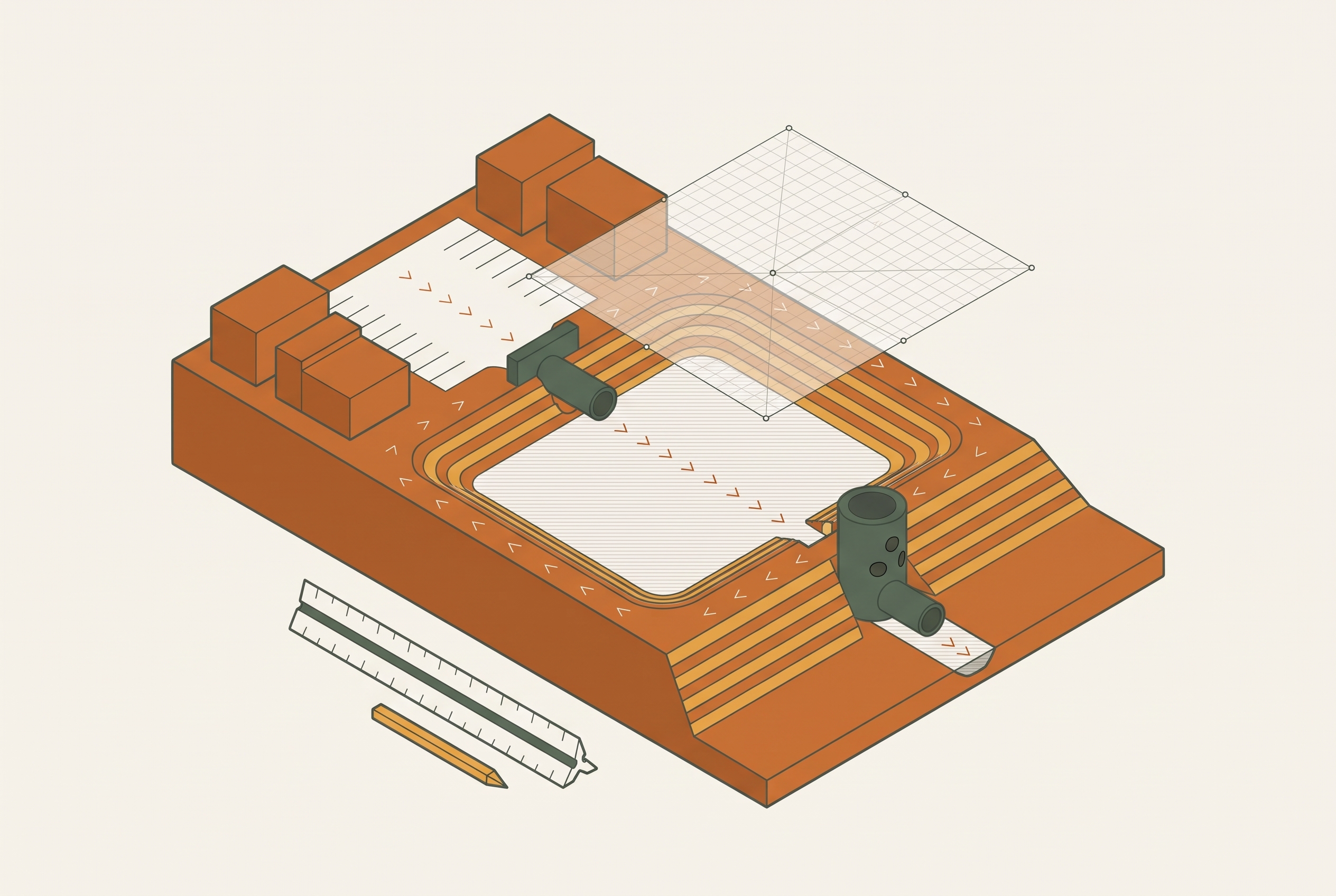
AI stormwater pond sizing and routing can now automate the iteration loop from runoff calculations through outlet sizing and multi-storm compliance checks. Its value is the ability to revise and test a coupled design without repeated manual intervention, while leaving site interpretation, jurisdictional judgment, and design approval with the engineer.
Why detention pond design is computation-heavy by nature
GDOT’s wet detention pond design course identifies seven interdependent components, including the forebay, permanent pool, aquatic bench, safety bench, detention storage, outlet control structure, and emergency spillway. Each imposes a separate sizing or geometry requirement. Yet none can be treated in isolation. Storage geometry sets how the water level rises during a storm, while the outlet controls how fast that storage empties. Storage geometry and outlet control must work together for the pond to meet its hydraulic objectives.
The course gives specific rules for these components. The forebay is sized to 0.1 inch runoff per impervious acre, while the permanent pool is sized to 0.1 inch runoff per impervious acre or water quality volume for larger drainage areas. The outlet control structure must keep the post-development 25-year peak at or below the pre-development peak. The emergency spillway must pass the 100-year peak flow. These requirements address different parts of the pond’s performance, so satisfying one does not establish compliance with the others.
A revision therefore propagates through the design. Changing an outlet orifice diameter shifts the stage-discharge relationship, alters the routed peak, and can change compliance with channel protection and overbank flood criteria. That change in storage may also mean checking the embankment geometry again. Separately, the permanent pool needs a water balance analysis using actual inflows and evaporation, with the pond bottom a minimum of 2 feet above the seasonally high water table over water supply aquifers. Manual iteration is consequently more than slow calculation, because every revision creates an opportunity to overlook a constraint that must be checked again.
What the routing calculation actually requires at each step
Runoff volume calculations and design storm inflow hydrographs show how much water the pond must handle. Storage estimation then translates the required volume reduction into a physical storage size before detailed geometry is finalized. Hydrology Studio describes this early estimate as a way to establish adequate storage before committing to pond geometry. Instead, the required hydraulic performance informs the space that the pond must provide.
The next task is developing the stage-storage curve, which relates water level to available storage. Its inputs can come from CAD contour areas, trapezoidal shapes, or manufactured underground chamber dimensions. Outlet design then develops the stage-discharge relationship for the relevant return periods by sizing orifices, weirs, and riser structures. Peak control is only one requirement here. Water quality and channel protection outlets must also draw down the volumes they serve within the required timeframes.
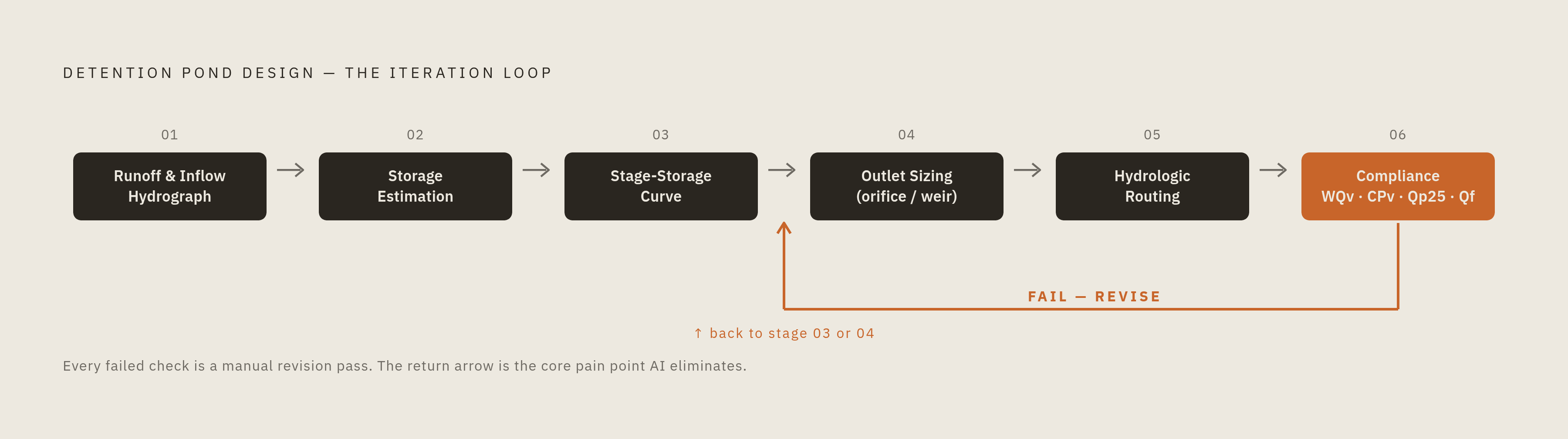
Routing combines those relationships with each design storm inflow hydrograph to produce an outflow hydrograph. The routed peaks are compared with pre-development peaks, and the results are checked against the applicable unified sizing criteria, including WQv, CPv, Qp25, and Qf. Every threshold must be satisfied by the same design. If a check fails, geometry or outlet dimensions change, and stage-storage development, outlet design, routing, and compliance checking repeat.
Connected basins make the sequence more demanding because one pond’s outflow becomes the next basin’s inflow. Underground detention adds chamber configuration, voided stone encasements, and dedicated outlet structure design to the coordinated sizing work. These calculations form a defined computational loop in which changes upstream can require new routing passes downstream.
How AI enters the routing loop and what it can run end to end
AI can execute this sequence as an automated workflow. It covers runoff volume calculations, detention facility sizing, outlet sizing, and compliance checks for multiple design storms. The decisive capability is control of the iteration. When a routing check fails, the workflow adjusts geometry or outlet dimensions and checks the revised design against all required storms without waiting for a manual revision.
An Integrated Explicit Hydrological Routing and Machine Learning Framework for Urban Detention System Design describes how machine learning learns the links among inflow characteristics, reservoir geometry, outlet conditions, and peak attenuation. Those relationships support rapid estimates of compliance across multiple design scenarios. This provides a computational basis for exploring alternatives efficiently. It does not, by itself, establish that every local requirement or site condition has been represented correctly.
On a large subdivision near Sacramento, Level AI automatically designed the numerous detention ponds needed to manage stormwater runoff during flooding events, as well as a tunnel under a parkway.
That application places AI-driven detention design at production scale rather than limiting it to an isolated sizing exercise. The broader design objective is to meet local ordinance requirements at minimum cost, which requires comparing workable configurations. Automated iteration lets them make that comparison with less manual input. The resulting design still requires engineering review, because a completed calculation loop establishes performance only against the conditions and constraints supplied to it.
The outlet control structure must keep the post-development 25-year peak at or below the pre-development peak.
Where AI cannot substitute for the engineer's judgment in detention design
A mathematically compliant pond can still be unsuitable for its site. Soil conditions affect actual infiltration and permanent pool stability, so the water balance depends on more than a correctly executed calculation. The reviewing engineer must interpret the subsurface information and recognize when regional assumptions do not represent the site.
A routed peak below the pre-development threshold can still damage a receiving channel that is already stressed. The routing model does not evaluate that condition unless the engineer explicitly includes it. Numerical compliance also leaves procedural obligations unresolved. The January 2026 Storm Drainage Design and Technical Criteria sets out the sequence of drainage reports, what kick-off meetings must cover, structure selection reports, and what is needed for facility certification for ponds and water quality SCMs.
Yasir Abduljaleel and colleagues’ 2023 study in Scientific Reports modeled nine proposed detention ponds in Renton, Washington, under future climate scenarios and found that pollutant-reduction performance varied with pond size and location. The engineer must interpret the implications for the particular asset rather than assume that a passing present-day result answers the question.
Organizations also risk judgment atrophy. Junior engineers who no longer work through every calculation need planned time with structured reviews, simulations, clear standards, and cases where real projects failed. Otherwise, proficiency with the interface can outpace the ability to recognize an implausible result. Substantive oversight is needed even as computation accelerates. When engineers no longer discover problems through doing the mathematics themselves, the review process must develop and exercise that judgment more intentionally.
How the Civil 3D and InfoDrainage toolchain connects AI routing to the full project deliverable
Routing efficiency is more useful when revised geometry connects directly to the drawing set. A separate analysis workflow leaves the firm with another task, which is transferring the accepted design into grading and project documentation. The practical objective is not simply to produce an acceptable hydrograph, but to keep the hydraulic design and the represented pond geometry aligned as the design changes.
Civil 3D 2027, released in April 2026, includes integrated InfoDrainage analysis and AI-assisted grading. Autodesk describes the InfoDrainage-powered capabilities as basic site analysis for storm event simulations. That scope deserves a precise distinction. Integrated analysis supports work within the CAD environment, but its availability alone does not establish that every detention design requirement is covered by an autonomous workflow.
InfoDrainage’s AI visualization places water accumulation results in spatial context, while automated pond creation with smart defaults produces geometry that can feed grading plans. Autodesk separately documents Machine Learning Deluge as an InfoDrainage feature. Civil 3D 2026.2 also added drainage tools and pond features, and Dynamo has 75-plus new nodes for stormwater control objects. Those nodes make related workflows scriptable. Parametric scripts can change pond geometry or outlet structures across multiple basins without having to revise each basin on its own.
These connections explain why compatibility with the existing toolchain is consequential. An AI routing workflow that runs within Civil 3D and InfoDrainage can speed up analysis while engineers keep the way they produce drawings. It also connects the selected hydraulic alternative to the geometry used for the project deliverable. The integration principle is therefore practical rather than promotional, because gains in routing speed are more useful when they do not create a separate reconciliation task.
What faster routing iteration means for how firms can staff and price detention projects
When repeated routing is no longer the dominant workload, engineering time shifts toward input setup, results review, and regulatory coordination. The firm needs less manual intervention between calculation passes, but still needs qualified attention at the points where assumptions and results are accepted. Review becomes the next throughput constraint. Faster computation does not automatically expand the capacity of that review function.
Hydrology Studio states that its wizard can design a detention pond in minutes through storage estimation, pond geometry, and outlet structure design. That claim illustrates how much conventional automation already removes from the manual sizing sequence. AI-driven workflows extend the approach by handling multi-storm compliance checks and parametric revisions within the iteration loop. AI-driven workflows remove the need for an engineer to stop, interpret a failed check, revise inputs, and restart the process each time.
The Sacramento subdivision illustrates why the benefit grows on projects with many basins. Automated design cuts the need to make the same manual changes for every pond, though connected basins still need to be reviewed together. No pond-per-engineer monthly comparison is established by that example. The supported business conclusion is qualitative, because reducing repeated routing work can release staff capacity for additional projects without adding people solely to perform more calculation passes.
Pricing determines who captures that efficiency. Under time-and-materials pricing, fewer routing hours generally mean fewer billable hours for the same scope. For routing-intensive work, the recommended response is to move toward fixed-fee pricing so that reduced iteration effort can improve margin and lower the client’s cost. A firm cannot convert calculation savings into reliable project throughput if approvals become an unmanaged queue.
How to bring AI routing into a civil firm's detention workflow without disrupting active projects
The firm should start with a single project type, the existing toolchain, and a defined approval process that retains licensed engineer review. Before the pilot begins, the firm should establish when review occurs and what it must cover. The stage-storage curve must use actual surveyed contour areas, and the water balance must support a permanent pool that can be maintained. Outlet draw-down must meet the jurisdiction’s timeframe requirements. Routed peaks must also stay below the pre-development thresholds that apply to each required design storm.
Jurisdictional alignment belongs before application of the generated design. The firm should confirm that its selected methodology, including TR-20, TR-55, or Rational, and its design storms match local criteria, checking software defaults for alignment. For assets with long design lives, climate scenario checking should also enter the review protocol. The Renton study supports scrutiny of future rainfall performance, including whether a larger permanent pool or higher outlet crest elevation may be needed. These decisions require engineering judgment.
Training must address interpretation as well as operation. Engineers need to learn how to formulate problems for AI, interpret probabilistic outputs, and recognize when results warrant additional scrutiny. For adoption across project types and disciplines, one-on-one, on-site implementation with the AI partner on actual firm projects can connect training to firm standards and past project data before the tool touches billable work. The distinction is between activating a feature and adopting a workflow, with review design and engineer development built in parallel so that faster iteration becomes dependable project capacity.
Sources
- Wet Detention Pond Design
Supplied the seven pond components and the specific sizing and peak-control rules for the forebay, permanent pool, outlet and spillway.
- Improving detention ponds for effective stormwater management and water quality enhancement under future climate change: a simulation study using the PCSWMM model
Provided the Renton, Washington study of nine detention ponds under future climate scenarios and how pollutant reduction varied with size and location.
- An Integrated Explicit Hydrological Routing and Machine Learning Framework for Urban Detention System Design
Described how machine learning links inflow, reservoir geometry and outlet conditions to peak attenuation for rapid compliance estimates.
- From Civil 3D to preliminary stormwater design: 5 InfoDrainage workflows - One Water Blog
Informed the discussion of InfoDrainage and Civil 3D workflows, including automated pond creation and Dynamo stormwater nodes.