AI Platforms That Train on a Firm's Own Past Projects
Firm-trained AI beats generic tools, but only on clean project data.
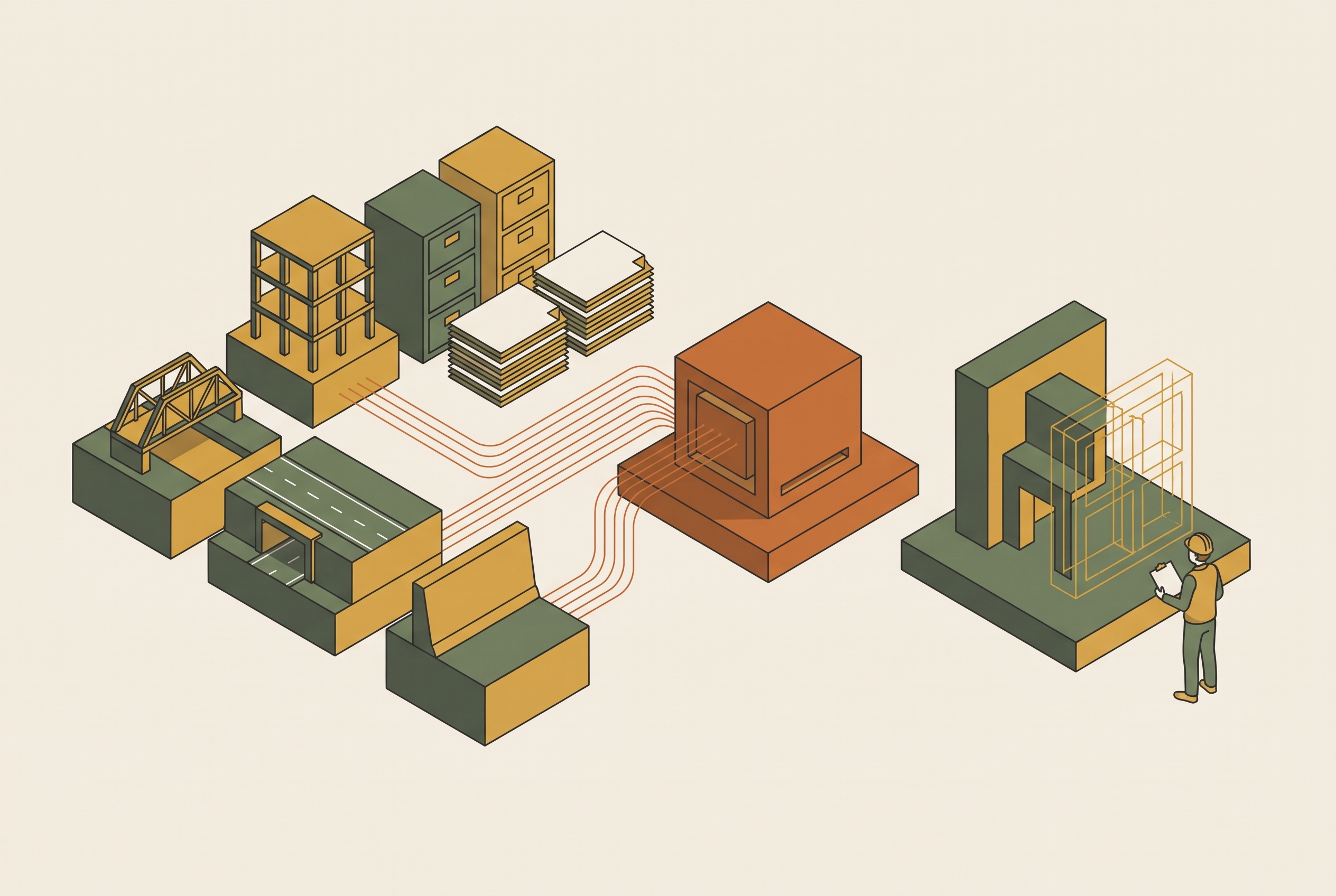
Why generic AI tools fall short for AEC firms, and what firm-trained alternatives promise instead
- Role: Opens the argument by establishing the core problem that motivates the entire piece — without this gap, there is no reason to evaluate a separate category of firm-trained AI.
- Generic AI tools start cold on every task: they carry no knowledge of how a specific firm designs, what standards it uses, or how its past projects were delivered.
- The AEC industry is shifting from point tools toward what Allplan's 2026 AI trends analysis calls a knowledge layer — AI that runs through the firm rather than being invoked for isolated tasks.
- That knowledge layer depends on structured data: clean BIM models, consistent analysis inputs, verified reference libraries, and feedback loops between past and current projects.
- The competitive premise: firms whose AI carries project history into every task can surface risks earlier, reuse prior decisions faster, and produce more consistent deliverables than firms whose AI starts from scratch each time.
- Note: Keep this section tight — one to two paragraphs in the article. The goal is to name the problem clearly so the reader immediately understands why the category exists. Do not rehearse a long history of AI in AEC; get to the structural gap fast.
What it means for AI to learn from a firm's own projects, technically
- Role: Grounds the argument in what is actually happening under the hood — moves from the promise to the mechanism, so principals can evaluate vendor claims with some precision.
- Firm-trained AI is not a single technique; it is a grounding approach: the system ingests the firm's drawings, specifications, standards, project history, and correspondence, then uses that corpus as the context for every subsequent task.
- Allplan's 2026 analysis identifies the mechanism precisely: AI systems analyze patterns across past project documentation and correspondence to highlight risks earlier — for example, comparing evolving geometry against thousands of prior issues or approval outcomes to predict where clashes or late-stage redesigns are most likely to emerge.
- Data-centric engineering as a discipline: Allplan frames this as treating structured data as a primary source of intelligence — the AI is only as good as the data it is grounded in, which means data quality is an engineering problem, not an IT problem.
- What this means practically: when the grounding data is strong, AI can generate cost estimates with meaningful precision on line items because it is drawing on historical actuals from comparable projects, not generic industry averages.
- The key distinction to draw for principals: this is different from fine-tuning a model (expensive, requires data science) — the more common commercial approach is retrieval-augmented generation, where the firm's documents are indexed and retrieved at inference time. Principals do not need to understand the technical detail, but they need to understand that "trained on your data" can mean very different things across vendors.
- Note: Do not turn this into a computer science explainer. One concrete analogy is enough. The goal is to give principals a question to ask vendors — "how does the system actually use our past project data at the moment it does a task?" — not to make them engineers.
What the firm's data must look like before any of this works
- Role: This is the section most platforms underemphasize and most principals underestimate — establishing it here, before the workflow examples, keeps the argument honest and sets up the implementation discussion later.
- Data readiness is the single most common gap between firms that see returns from firm-trained AI and firms that do not.
- The practical warning from implementation experience: if historical project data is scattered across spreadsheets, file servers, and someone's inbox, the first month of any AI initiative will be spent cleaning and organizing it — not producing output.
- Roughly 52% of AEC firms still use paper during the design phase — per a 2026 industry survey — and only a small fraction have achieved full digitization, which means for many firms, the prerequisite for firm-trained AI is a digitization initiative that precedes AI adoption.
- What "clean data" requires in an AEC context: consistent file naming and folder structure, BIM models that are object-based rather than geometry-only, specifications stored in searchable formats, and project correspondence that is organized and retrievable — not archived in email threads.
- Allplan points to the value of connecting inspection records, sensor data, and as-built models: when structured correctly, these allow AI to identify deterioration patterns, predict maintenance requirements, and validate design assumptions against historical evidence.
- The data readiness audit is therefore not an IT task — it is a strategic prerequisite that determines which workflows are ready for AI now and which ones need groundwork first.
- Note: Anchor this section in what principals will actually face when they start — not abstract data science. A concrete example of what "unready" data looks like (project specs in PDFs named "Final_v3_FINAL_use this one") lands better than a taxonomy of data types.
The workflows where firm-specific context changes the output in ways generic AI cannot replicate
- Role: Now that the mechanism and prerequisites are established, this section delivers the evidence — specific workflows where firm context is not a nice-to-have but the thing that makes the output usable. This is the heart of the argument.
- The value of firm-trained AI is not uniform across all AEC workflows — it concentrates in the tasks where institutional knowledge is the primary input: detail reuse, cost estimation, drawing QA, proposal assembly, and risk identification.
- The firm's own details carry firm-specific standards, preferred manufacturers, and QA history — a generic detail library does not.
- Nomic runs quality control and coordination review across a firm's own drawings, specifications, and project files — reading a whole set rather than one sheet at a time, which is where coordination errors live, and returning findings with sheet references for a reviewer to confirm.
- It covers drawing review, submittal review against the specification, RFI research over the project archive, building code checks, and plain-language search of past projects.
- The firm-specific element: RFI research and submittal review are only useful if the system has access to the actual project archive — a generic AI cannot answer "how did we handle this condition on the Riverside project?"
- Machine-learning estimators trained on historical project data can achieve a level of line-item cost precision that is only achievable when the model is calibrated to the firm's actual cost history, subcontractor relationships, and regional conditions, not industry averages.
- Flowcase's 2026 AEC AI guide describes Joist AI as focusing specifically on AEC marketing and proposal workflows — using AI to find, curate, and organize content scattered across legacy systems and shared folders, directly addressing the problem of locating past project descriptions when a deadline hits.
- Flowcase itself centralizes CVs, resumes, and project credentials so bid teams can pull relevant experience and tailor it per opportunity in minutes rather than hunting through shared drives.
- Firm-specific context is the entire value here: a generic AI cannot match a firm's past projects to a new solicitation without access to the firm's project history.
- Document Crunch reviews contracts, specifications, and other project documents to identify risks and obligations, delivering actionable insights and on-demand answers from bid pursuit through project execution.
- When the system has access to the firm's prior contracts and project outcomes, it can flag risks the firm has actually encountered — not just generic risk categories.
How platforms in this category differ in their approach to grounding and what that means for firms evaluating them
- Role: Transitions from "what is possible" to "how do you evaluate the field" — giving principals a framework for the buying decision rather than a list of names.
- Platforms in this category vary along three dimensions that matter for AEC firms: how they ingest and index firm data, which workflows they cover, and whether they operate inside the tools the firm already uses or require a workflow change.
- Scope of data ingestion:
- Some platforms index documents and specifications only (useful for QA, proposals, and contract review); others read drawing files directly and operate at the element level (useful for takeoff, coordination, and BIM workflows).
- Workflow coverage:
- Narrow platforms (Pirros for Revit detail reuse, Document Crunch for contract risk, Joist AI for proposals) do one workflow well and integrate into the firm's existing process at that point.
- Broader platforms attempt to cover multiple workflows through a single agent layer — the trade-off is configurability versus depth at any given task.
- In June 2026, Autodesk announced its AI Assistant for construction workflows in Forma was out of beta (with the underlying Project Data Agent having exited beta in March 2026), positioned as a project-level agent that can work across connected specifications, issues, RFIs, and other project information — representing the ecosystem approach where firm data is centralized inside an existing platform.
- Workflow fit vs. workflow change:
- The most common adoption failure is requiring the firm to change how it works to accommodate the AI — reorganizing file structures, switching project management platforms, or abandoning existing tools.
- Platforms that operate inside Civil 3D, Revit, Bluebeam, and the firm's existing document environment impose the least disruption and tend to see faster adoption.
- An AI partner that learns the firm's existing standards and works inside the tools already on the engineer's computer removes this barrier entirely — the AI fits the firm rather than the firm fitting the AI.
- Data privacy and governance:
- Principals evaluating platforms in this category should ask explicitly whether firm data is used to train shared models — a firm's project history is proprietary, and grounding that works by pooling firm data across clients defeats the purpose of firm-specific context and introduces competitive risk.
- The right answer from any platform in this category is that each firm's data stays private to that firm and is never used to train models that serve other clients.
- Note: This section is the place to weave in the company positioning naturally — the criteria listed (works inside existing tools, fits the firm rather than requiring workflow change, data privacy) are the genuine differentiators to surface here. Do not frame it as a product pitch; frame it as what a rigorous evaluation looks like.
What adoption actually requires from the firm — people, process, and a phased approach
- Role: Shifts from platform evaluation to implementation reality — the section most principals need most and most vendor content skips. Builds on the data readiness argument from earlier and extends it to the human and organizational dimensions.
- The majority of AEC firms that adopt AI but see no measurable return are not failing because of the tools — they are failing because of implementation depth and workflow integration.
- The phased roadmap:
- Phase 1 — Data and readiness audit (weeks 1–4): audit data maturity, map pain points by cost and staff stress, evaluate team attitudes, set measurable objectives.
- Phase 2 — Scope one pilot with measurable goals (weeks 4–8): one workflow, one team, one outcome — not a firm-wide rollout.
- Phase 3 — Execute with human-in-the-loop oversight (months 2–6): pilot operational with metrics tracking; licensed professionals review every output.
- Phase 4 — Data-driven go/no-go decision (month 6): results analysis before scaling.
- Phase 5 — Multi-workflow expansion with governance and training (months 6–18): scale only what is proven.
- The human element:
- The single most cited adoption failure mode is under-investing in people — most AEC firms spend only a small fraction of their technology budget on training, then are surprised when adoption stalls.
- Designating an AI champion or coordinator who owns the rollout and connects technology decisions to workflow realities is essential — not a technology decision, a people decision.
- Trust in AI systems is not installed by training; it accrues through experience with small wins, transparent failure modes, and visible human oversight. A mentorship model — where senior practitioners train the AI through curated feedback on their best work — reframes their role from "users of the AI" to "trainers of the firm's AI," making them advocates rather than resisters.
- Bluebeam CEO Usman Shuja: "The biggest barriers to AEC technology adoption in 2026 aren't cost — they're complexity, culture and connection."
- Accountability in licensed engineering work:
- Every AI output in licensed engineering work must be reviewed and approved by a licensed professional — automation does not replace accountability, and any platform that suggests otherwise is the wrong platform for a licensed firm.
- Human-in-the-loop oversight is not a limitation of current AI; it is the correct operating model for AEC, and it is the model that the best platforms are designed around.
- Structured executive support:
- In October 2026, PSMJ Resources announced the AEC AI Acceleration Workshop, a two-day executive training program coming to five major U.S. cities starting in December 2026 in San Diego, with additional sessions in Scottsdale, Austin, Boston, and Nashville in 2027, with the first session in San Diego and additional sessions in Scottsdale, Austin, Boston, and Nashville planned for 2027 — participants select pilot projects, define success metrics, build a realistic budget, assign ownership, and map change management steps, leaving with a 90-day action plan that names owners and dates.
- Note: The accountability point is where the company's stance on licensed professional review belongs — surface it as a principle the whole industry should hold, not as a product feature. The PSMJ workshop is the one named event from the sources; carry its details exactly as listed above since readers may act on them.
How to measure whether firm-trained AI is actually delivering — and what good looks like
- Role: Closes the argument by giving principals the evaluative frame they need after understanding the mechanism, the prerequisites, and the implementation path — turns the piece from informational into actionable.
- The right metrics for firm-trained AI are not hours saved on isolated tasks — they are revenue per person, project throughput, and bid-to-win ratios over time, because those are the measures that reflect whether the AI is carrying firm context effectively across the whole delivery cycle.
- Workflow-level signals that grounding is working:
- Proposal cycles shorten because the system retrieves relevant past project content without staff hunting for it.
- Cost estimates become more accurate over successive projects because the model is calibrated to the firm's actual history, not industry benchmarks.
- Drawing QA catches coordination issues earlier in the set — before permit submission, not after the AHJ comments.
- Detail reuse increases, and with it consistency of standards across projects — a measurable QA improvement.
- The throughput signal:
- A documented real-project result: work that had previously consumed many hundreds of hours was completed in a fraction of that time when AI carried firm context into the task — not an isolated time saving on one step, but a compression of the full delivery cycle.
- This kind of throughput gain is only achievable when the AI is grounded in the firm's actual standards and project history — a generic tool applied to the same work would require the engineer to supply that context manually at every step, eliminating most of the gain.
- What the go/no-go gate at month six should measure:
- Not "did the pilot work technically" but "did it change a metric that matters to the business" — throughput on the piloted workflow, error rate in deliverables, or hours recovered per project that were redeployed to billable work.
- The compounding advantage:
- Allplan's analysis frames the long-term value: it becomes far easier and quicker to learn from past projects, leading to faster creation of better design proposals — the firm's AI gets more useful over time as the corpus of completed projects grows, which is a compounding advantage that generic tools cannot replicate.
- Firms that begin grounding their AI now accumulate this advantage; firms that wait start the accumulation later and compete against firms whose AI already carries years of institutional knowledge.
- Note: Close on the compounding point — it is the strongest argument for acting now rather than waiting for the technology to mature further, and it lands harder than any efficiency statistic. Keep the tone measured, not urgency-driven.
Sources
- 2026 AI Construction Trends: 25+ Experts Share Insights - Digital Builder
Supplied the expert view on AEC technology adoption barriers, including the Bluebeam CEO's remark on complexity, culture and connection, and the broader 2026 AI trends context.