AI-Generated SWPPP Preparation for Civil Engineering Firms
AI can draft the routine SWPPP work, but engineers still own the judgment.
A stormwater compliance plan ranks among the most document-heavy, regulation-layered deliverables a civil engineering firm produces. Preparing one well means synthesizing site data, federal and state permit conditions, BMP selection logic, and narrative compliance mapping into a single coherent plan that a regulator can audit and a contractor can actually follow in the field. A complete SWPPP has to satisfy the applicable Construction General Permit framework, either EPA's CGP in jurisdictions where EPA serves as the NPDES permitting authority, or a state-issued CGP along with whatever additional state-level NPDES requirements apply. Each of these frameworks carries its own BMP menus, its own inspection schedules, and its own narrative requirements, so if a firm works across state lines, it is rarely filling out one template twice. None of this work ends at submission. A SWPPP has to be updated when site conditions change, when best management practices get modified in the field, and after inspections turn up deficiencies. The labor recurs across the life of the project, continuing well past permit issuance.
Automatable and non-automatable parts of the SWPPP workflow
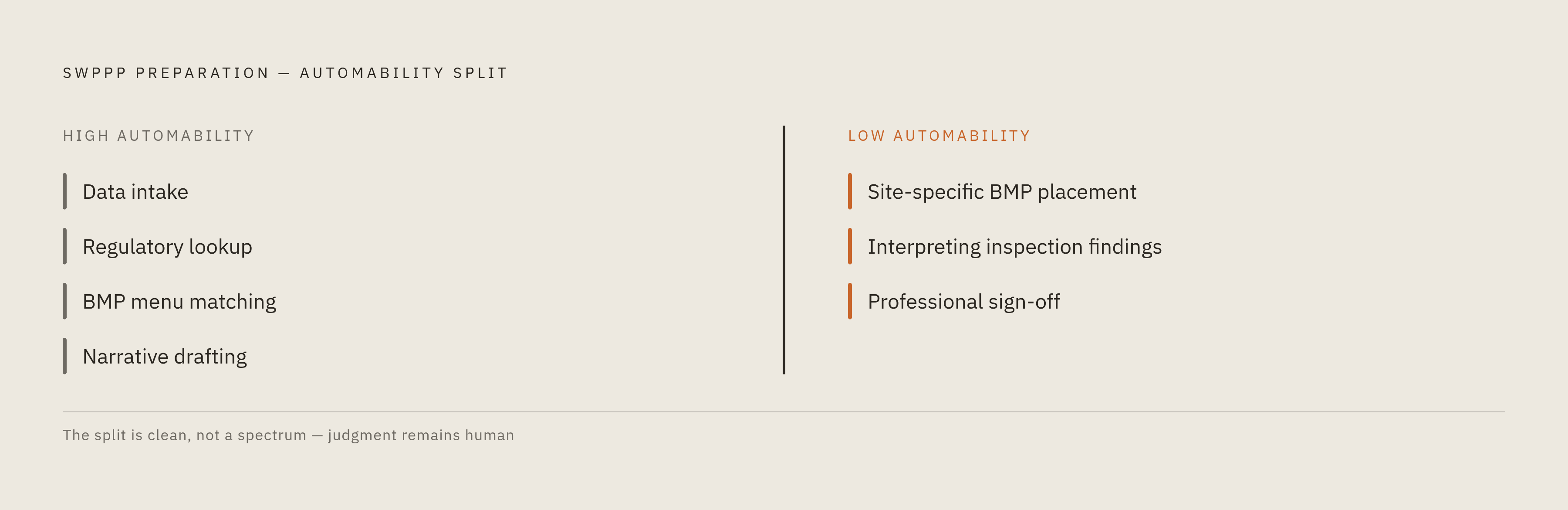
The SWPPP workflow splits cleanly into two categories, and the split is what determines where AI belongs in the process. One category covers tasks with high automability: data intake, regulatory lookup, BMP menu matching, and narrative drafting built from templates. These are structured, rule-governed, and repeatable across projects, which is exactly the kind of work that machine reasoning handles consistently. The other category covers tasks with low automability: deciding where a BMP actually gets placed on a specific site, interpreting what an inspection finding means for the rest of the plan, and exercising the professional judgment that ultimately puts a stamp on the document. Site-specific BMP placement depends on topography, contractor capability, and construction sequencing in ways no intake form fully anticipates. A deficiency in one control can affect the adequacy of controls elsewhere on the site, so interpreting inspection findings takes a judgment call that depends on field conditions. And the professional sign-off itself sits outside the reach of automation entirely, because licensure law assigns that responsibility to a named individual, not a tool. Nyokum and Tamut (2025) identify the "black-box" interpretability problem, the difficulty of knowing why a model produced a given output, as a significant challenge for trust in safety-critical engineering decisions. SWPPP sign-off belongs squarely in that category. The line between automatable and non-automatable work in this workflow is a matter of professional accountability, not convenience.
How AI handles site data intake and regulatory mapping
The first labor-intensive step in SWPPP preparation, gathering site characteristics, permit conditions, and applicable BMP requirements, is also the step where AI produces the largest time reduction with the lowest risk of consequential error. Structured intake forms guided by AI prompt logic can systematically collect soil data, drainage area calculations, disturbance acreage, receiving water designations, and project phasing information. These are the inputs that drive every subsequent section of the plan, so capturing them completely and consistently at the outset determines the accuracy of everything the plan later relies on. RationalGo's EPA SWPPP tracker illustrates one end of this capability: it is an AI-powered compliance monitoring app built to track inspections, BMP conditions, corrective actions, and NPDES permit requirements, though it functions as a tracking tool rather than a drafting tool with guided intake or input-validation features. On the regulatory side, natural language processing tools can parse the applicable Construction General Permit and any state-level NPDES permit, pull out the BMP requirements relevant to a project's specific parameters, and surface only the sections that actually apply. That capability eliminates the manual read-through of lengthy permit documents that has historically consumed hours of an experienced engineer's time on every new project. Nyokum and Tamut (2025) find that NLP is an emerging capability in civil engineering with potential for processing regulatory and specification documents, but they also note that NLP applications in the field remain at an early stage. For a firm, the practical result is a pre-populated regulatory matrix, permit conditions already mapped to project parameters, and the engineer's job becomes auditing it.
AI-assisted BMP selection and the reasoning it can and cannot supply
BMP selection is the point in the workflow where AI's reasoning becomes most visible, and also where its limits become most consequential. AI tools can match project parameters, slope, soil erodibility, drainage area, and proximity to waterways, to permit-approved BMP categories such as silt fences, sediment basins, inlet protection, and stabilized construction entrances, using rule-based or machine-learning logic trained on those categories. The same tools can generate the narrative explanation tying each selected BMP to the specific permit condition it satisfies, a task that traditionally consumed significant drafting time for something that follows a fairly predictable structure. Casemark's SWPPP workflow shows this directly: it produces organized BMP selections with design specifications and maintenance schedules from site inputs, so the engineer reviewing the output doesn't face a blank page. What AI cannot supply is judgment tied to physical reality on the ground. Deciding which BMP configuration is actually constructable given site topography, contractor capability, and sequencing constraints requires a person who understands how the project will actually be built, not just what the permit allows. Soil conditions that deviate from the USDA soil survey data an AI tool ingests, filled areas, subsurface anomalies, disturbed soils, call for on-site evaluation that no dataset captures in advance. And when a permit's standard BMP menu doesn't include a measure the site clearly needs, the engineer has to justify an equivalent alternative, a task that calls for regulatory interpretation. The common objection that AI-generated BMP selection is too generic to be useful misses how the tool actually behaves: the more precise the site data fed into the system, the narrower and more applicable its output becomes. The engineer's role shifts from originating the selection to verifying and placing it correctly, which is a faster and more targeted use of that engineer's expertise than starting from nothing.
Narrative generation: AI drafts and engineer rewrites
The narrative sections of a SWPPP, the site description, the pollution sources inventory, the BMP implementation sequence, the inspection procedures, and the amendment protocols, are structured, regulation-constrained prose, and that makes them exactly the kind of writing AI generates reliably when given accurate inputs. AI tools produce consistent, permit-compliant language for standard sections like operator identification, project description, receiving water description, and BMP maintenance schedules, sections that firms have historically rewritten from prior-project templates by hand, often introducing small inconsistencies in the process. These tools also maintain traceability by ensuring each BMP narrative cites the specific permit condition it addresses, a requirement that is simple in principle but tedious to track manually across a document that can run to dozens of pages. Reviewing a populated draft is a fundamentally different task than drafting from a blank page, and it is where the engineer's time produces the most value per hour spent. An engineer reading an AI-generated narrative is checking it against what was actually observed on site. The review can therefore move quickly and focus precisely on the places most likely to contain errors. Two categories of narrative demand that kind of focused rewriting. The first covers any language that depends on field observations the engineer has made directly: the condition of existing drainage features, how close actual construction activity sits to sensitive areas, staging decisions that never made it into the intake form. The second covers sections where state or local requirements diverge from the federal CGP baseline, because AI tools trained on general permit language may not reflect a particular state's addenda or a local municipal separate storm sewer system's specific conditions.
For a firm, the practical result is a pre-populated regulatory matrix, permit conditions already mapped to project parameters, and the engineer's job becomes auditing it.
Compliance mapping: tracking plan requirements against permit conditions
The compliance mapping layer of a SWPPP confirms that every required element is present, addressed, and traceable back to the permit condition that demands it, and that kind of structured cross-referencing is precisely where AI reduces the risk of a missed requirement slipping through. AI tools check whether each section required by the applicable permit, whether the CGP or a state equivalent, has actually been populated, and they flag any required element that is absent from the draft. They can also generate a compliance matrix mapping each permit condition to the specific SWPPP section and BMP that addresses it, a document that regulators and inspectors increasingly expect firms to produce alongside the plan itself. Beyond checking what's already in the draft, these tools can flag conditions the intake data suggests may apply, proximity to a 303(d)-listed impaired water body, for instance, that haven't yet been addressed anywhere in the document. What AI cannot do is judge whether a plan element substantively satisfies a permit condition rather than merely occupying the section where that condition belongs, and that distinction needs the engineer's interpretive judgment. Engaging directly with a regulator when a compliance question is contested, or when a permit condition reads ambiguously, also remains work for a person, not a system. The practical outcome for a firm is that the engineer receives a gap report instead of performing the gap check from scratch, and can direct attention to the specific items flagged rather than auditing the entire document line by line.
A realistic AI-assisted SWPPP process inside a civil firm
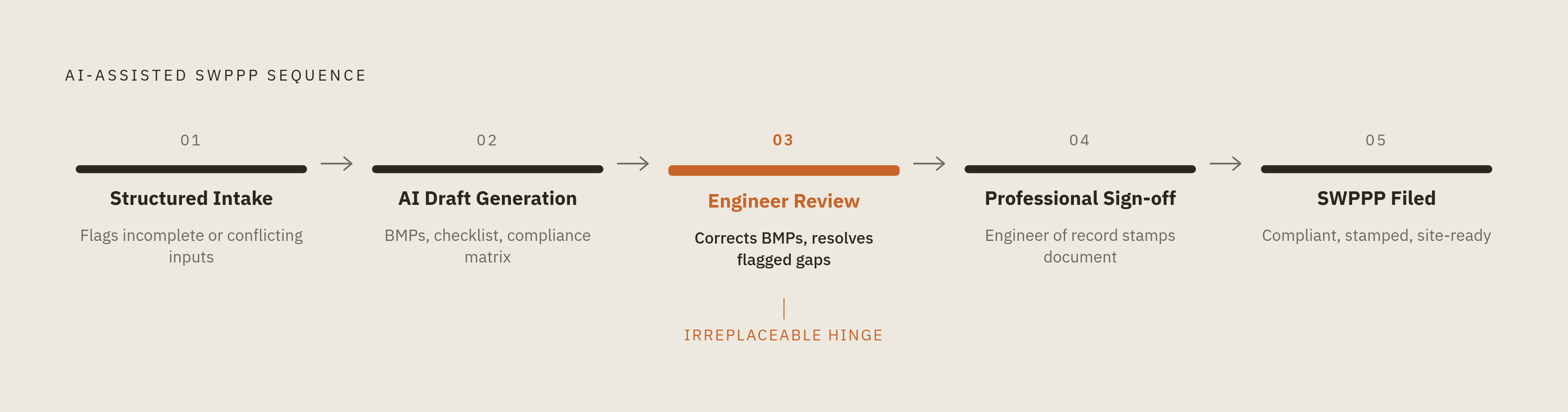
A practical AI-assisted SWPPP process follows a defined sequence: structured intake, AI draft generation, engineer review and site-specific revision, a compliance gap check, and licensed professional sign-off. Each step moves faster than its manual equivalent, and none of them gets eliminated. The first step has an engineer or staff member complete an AI-guided intake covering project parameters, the applicable permit, site characteristics, and project phasing, with the AI flagging incomplete or conflicting inputs before drafting even begins. The second step has the system produce a populated SWPPP draft: a site description narrative, a pollution sources inventory, a BMP selection table with supporting rationale, an inspection checklist, an amendment log template, and a compliance matrix keyed to the applicable permit. Casemark's SWPPP workflow demonstrates this generation step from structured inputs, while a tool like RationalGo's EPA SWPPP tracker serves a different function: compliance and inspection monitoring. The third step is where the engineering judgment that no automated system can supply gets applied: the licensed engineer reviews the draft against direct knowledge of the site, corrects BMP placement and configuration, revises any narrative sections where site-specific conditions weren't captured in the intake, and resolves any compliance gaps the system flagged. The engineer is auditing a populated document rather than originating one, so that review moves faster and lands more precisely. The fourth and final step is licensed professional sign-off, where the engineer of record confirms the complete document reflects actual site conditions and sound professional judgment before stamping it. No AI output leaves the firm without that review. For a firm's throughput, the implication is direct: a task that previously consumed a mid-level engineer's full day can compress into a focused review session, freeing that engineer for higher-judgment work or additional project capacity elsewhere in the firm.
Fitting AI to the firm's existing tools and data
AI-assisted SWPPP preparation delivers its throughput gains only when the tool works inside a firm's existing project delivery environment, pulling from the firm's own project data, permit libraries, and standard details, so engineers don't have to relearn a new system or re-enter information they've already produced elsewhere. That starts with data access: the AI needs to work with the grading plans, drainage reports, and soil reports a firm already produces, in the CAD files, PDFs, and Excel sheets those documents already exist in, rather than demanding conversion into some proprietary format before the tool can use them. It also extends to permit and BMP libraries: these need to reflect the specific jurisdictions a firm actually works in, not a generic national template that requires manual adjustment for every state or local permit encountered. Output documents matter too: they should arrive in the formats a firm already uses for deliverables, not a new document type the engineer has to reformat before it can carry a stamp. Data handling carries its own weight here. SWPPP documents contain sensitive client project information, site locations, owner information, and financial details implied by project scope, and an AI tool that trains on or retains that data introduces a liability no firm handling regulated project data can accept. Firms in this position need AI that runs on infrastructure they control, or that comes with contractual guarantees that client data is never used to train a model. The distinction that ultimately separates tools that get adopted from tools that get abandoned after a pilot comes down to which side bends: a firm that adapts its own workflows to fit an AI tool absorbs friction and resistance at every step, while a firm whose AI tool adapts to its existing workflows sees faster adoption and more reliable output from day one.
The professional accountability boundary AI does not cross in licensed engineering work
AI acceleration of SWPPP preparation changes the labor profile of the work without redistributing who is responsible for it. The licensed engineer's review and stamp remain the legal and ethical boundary that no automation crosses, and the specific failure mode firms need to guard against is treating AI output as a finished product rather than as a draft awaiting review. The regulatory basis for this is direct: SWPPPs prepared for permitted construction sites function as compliance documents, and the engineer or qualified person who certifies the plan attests to its accuracy and adequacy under legal exposure that attaches to that individual, not to any tool used along the way. In practice, that means every AI-generated section of a SWPPP needs review by someone with the site knowledge and regulatory understanding to catch what the AI cannot know: a missed site condition, a permit requirement specific to a local MS4, an inspection finding that invalidates an earlier BMP selection. The review should carry real weight, not just function as a formality. An engineer ought to treat an AI draft the way they would treat a junior engineer's first submission: useful, often accurate, but requiring independent verification before it carries the firm's stamp. For firm principals, AI-assisted SWPPP preparation does not diminish the importance of having a licensed engineer on the work. It increases the value of that engineer's time by directing the hours spent toward judgment. The stamp means more when the engineer behind it has spent the review focused on exactly the work only an engineer can do.
Sources
- Frontiers
Supplied the points on black-box interpretability and the early stage of NLP for processing regulatory documents in civil engineering.
- Harnessing AI-Powered Tools For Compliance — Part 2 - IECA News Center
Informed the discussion of where AI-powered tools fit in compliance workflows such as SWPPP preparation and tracking.